
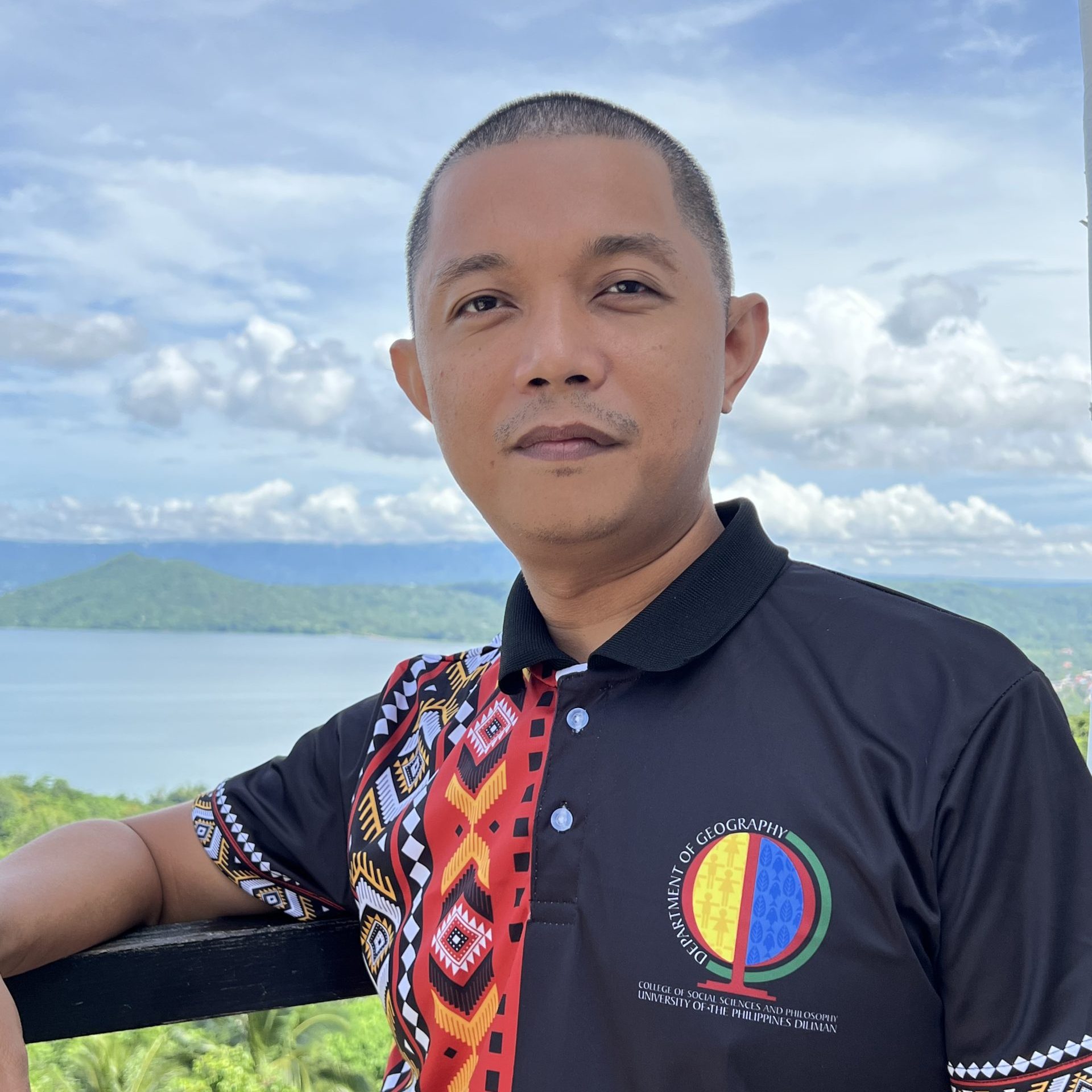
JAKE ROM D. CADAG, PhD, Associate Professor
Email: jdcadag@up.edu.ph
Office Phone: 89818500 ext. 2222; Room Number: PAV 2232
Personal Website: https://jakecadag.wordpress.com/
I am an Associate Professor of Geography at the University of the Philippines Diliman. I hold a PhD in Geography and Spatial Planning and a master’s degree in Social Sciences and Humanities. My professional expertise includes disaster risk reduction and management, climate change adaptation, and mapping (i.e., cartography and geographic information systems). I am skilled in community work and the use of participatory methods and tools involving various stakeholders and community members, particularly marginalized sectors (i.e., women, older adults, children, etc.). I have extensive experience in research writing, employing both qualitative and quantitative methods. My fieldwork spans several countries, including the Philippines, France, Indonesia, and Cape Verde. I have been involved in research projects related to Disaster Risk Reduction and Climate Change Adaptation (DRR-CCA), funded by local and international NGOs and institutions.
EDUCATION
> P.h.D in Geography and Spatial Planning, Université Paul Valéry – Montpellier III
> Master in Social Sciences and Humanities, Université Paul Valéry – Montpellier III
> Bachelor of Science in Geography, University of the Philippines
SPECIALIZATION
> Disaster studies
> Disaster Risk Reduction and Climate Change Adaptation (DRR-CCA)
> Participatory Methods for DRR-CCA
> Geographic Information System
> Climate and Disaster Risk Information
> Risk-informed development
COURSESTAUGHT
> Environmental hazards and disasters (Service-learning course)
> The geography of natural hazards and disasters
> Research methods in geography
> Field methods in geography
> Seminar in geography
> Places and landscapes in a changing world
> Transportation geography
> Urban-rural geography
AWARDS AND GRANTS
> 2025 Outstanding Young Scientist Award (The National Academy of Science and Technology, Philippines (NAST PHL)
> 2025 Centennial Professorial Chair Award (University of the Philippines Diliman Office of the Vice President for Academic Affairs)
> 2017-2024 International Publication Award (University of the Philippines Diliman Office of the Vice President for Academic Affairs)
> 2008-2009 Recipient of the Duo-France Scholarship Grant by the French Embassy to the Philippines for the completion of the Master’s Degree in the University of Paul Valery Montpellier III, France.
> 2009-2013 Recipient of the French Embassy Scholarship Program with cofinancing of the MIA-VITA (MItigate and Assess risk from Volcanic Impact on Terrain and human Activities) in collaboration with DOST-PHIVOLCS and through funding of the European Commission for the completion of Doctoral Degree in the University of Paul Valery Montpellier III, France.
RESEARCH PROJECTS
> 2024-Ongoing: SAKUNA: retrieving non-Western understandings of disasters in the Philippines – Project funded by the Tarling Trust.
> 2024-Ongoing: Fire resilience in Metro Manila – Project funded by the UP Resiliennce Institute.
> 2024-Ongoing: Localizing Climate and Disaster Risk Reduction in the Philippines – funded by the UP OVCRD Outright Research Grant.
> 2023 – Ongoing: Negative impacts of DRR-CCA to the natural environment – through Research Load Credit.
PUBLICATIONS
BOOKS
> Alcántara-Ayala, I., Gomez, C., Chmutina, K., van Niekerk, D., Raju, E., Marchezini, V., Cadag, J. R., & Gaillard, J. (2023). Disaster Risk (1st ed.). Routledge. https://doi.org/10.4324/9781315469614
> Cadag J.R.D. (2024) (editor). National Capital Region Climate and Disaster Risk Atlas (NCDRA). Department of Human Settlements and Urban Development – NCR and the UP Department of Geography (Geography 192 midyear class).
JOURNAL ARTICLES
> Cadag, J. R. (2024). Problems and promises of postmodernism in (re)liberating disaster studies. Disaster Prevention and Management: An International Journal, ahead-of-print(ahead-of-print). https://doi.org/10.1108/DPM-06-2023-0153
> Le Dé, L., Gaillard, J., Baumann, L., & Cadag, J. R. (2024). Measuring Vulnerability: By Whom and for Whose Benefit? The Significance of Participation. Vulnerability, Territory, Population: From Critique to Public Policy, 195.
> Gaillard J.C., Pangilinan M.R.M., Cadag J.R.D., Le Masson V. (2008) Living with increasing floods: Insights from a rural Philippine community. Disaster Prevention and Management (ISI), 17(3): 383-395.
> Le De, L. L., Baumann, L. L., Moatty, A., Masson, V. L., Kikano, F., Fayazi, M., . . . Cadag, J. R. D. (2023). Alternatives for sustained disaster risk reduction: A re-assessment. Jamba : Journal of Disaster Risk Studies, 15(1), 1487. doi:doi:10.4102/jamba.v15i1.1487
> Cadag, J. R. (2022). Decolonising disasters. Disasters, 46(4), 1121-1126. https://doi.org/10.1111/disa.12550
> Saguin, K.K., Lopez, Y., Cadag, J.R., De Guzman, M. & Garcia, E. (2021) Geography’s trajectories in Philippine higher education. Transactions of the Institute of British Geographers, 00, 1– 5. https://doi.org/10.1111/tran.12484
> Le Dé L., Gaillard J.C., Gampell A., Loodin N., Cadag J.R.D. (2020) Participatory mapping 2.0: new ways for children’s participation in disaster risk reduction. Australian Journal of Emergency Management 35(2): 34-42.
> Cadag, J.R.D. (2019). Disasters. International Encyclopedia of Human Geography. Elsevier.
> Gaillard, J.C., Cadag, J.R.D., Rampengan, M. (2019). People’s capacities in facing hazards and disasters: an overview. Natural Hazards 95: 863.
> Kerstin, Z., Cadag, J.R.D., Escarcha, J., Garnett, S. (2018). Perceived heat stress increases with population density in urban Philippines. Environmental Research Letters.tps://doi.org/10.1088/1748-9326/aad2e5
> Cadag, J. R. D., Petal, M., Luna, E., Gaillard, J. C., Pambid, L., Santos. G. V. (2017). Hidden disasters: Recurrent flooding impacts on educational continuity in the Philippines. International Journal of Disaster Risk Reduction. https://doi.org/10.1016/j.ijdrr.2017.07.016.
> Gaillard, J. Cadag, J.R.D., Gampell, A., Hore, K., and Le De, L., McSherry, A. (2016). “Participatory numbers for integrating knowledge and actions in development.” Development in Practice 26(8): 998-1012.
> Ton T.K., Gaillard J.C., Cadag J.R.D., Naing A. (2016) It takes two to tango: Integrating meteorological knowledge and actions for disaster risk reduction. Climate and Development.
> Gaillard J.C., Hore K., Cadag J.R.D. (2015) Participatory mapping for disaster risk reduction: A Review. The Globe 76: 31-38.
> Texier-Teixeira P., Chouraqui F., Perrillat-Collomb A., Lavigne F., Cadag J.R.D., Grancher D. (2014) Reducing volcanic risk on Fogo Volcano, Cape-Verde, through a participatory approach: which out coming? Natural Hazards and Earth System Sciences, 14: 2347-2358.
> Gaillard J.-C., Monteil C., Perrillat-Collomb A., Chaudhary S., Chaudhary M., Chaudhary O., Giazzi F., Cadag J.R.D. (2013) Participatory 3-dimensional mapping: a tool for encouraging multi-caste collaboration to climate change adaptation and disaster risk reduction. Applied Geography (ISI), 45: 158-166
> Cadag J.R.D., Gaillard J.-C. (2012) Integrating knowledge and actions in disaster risk reduction: The contribution of participatory mapping. Area (ISI), 44(1): 100-109.
> Cadag J.R.D., Gaillard J.-C. (2010) Pamamrisk: Participatory Methodology for Assessing and Managing Risk. Tao Shelter, 7-9: 10-13.
> Gaillard J.-C., Cadag J.R.D. (2009) From marginality to further marginalization: Experiences from the victims of the July 2000 Payatas trashslide in the Philippines. Jàmbá: Journal of Disaster Risk Studies (DHET List of Approved South African Journals), 2(3): 195-213.
BOOK CHAPTERS
> Cadag, J. R. D (2024). Depoliticisation is disaster risk creation: Insights on non-government organisations’ disaster prevention and humanitarian response in the Philippines. In Isabelle Desportes, Alice Corbet, Ayesha Siddiqi (eds.) Depoliticising Humanitarian ActionParadigms, Dilemmas, Resistance. Routledge. https://www.routledge.com/Depoliticising-Humanitarian-Action-Paradigms-Dilemmas-Resistance/Desportes-Corbet-Siddiqi/p/book/9781032535098
> Le Dé, L., Gaillard, J., Baumann, L., & Cadag, J. R. D (2024). Mesurer la vulnérabilité: de la pertinence de la participation. Vulnérabilité, territoire, population, 205-223.
> Cadag, J.R.D., Andal, S., Deus, J.A.R. (2022). Bridging the gaps between DRR-CCA and development planning. in Climate Change and Disaster Resilience edited by Joaquin Jay Gonzales, Roger Kemp and Alan Roper. McFarland Academic.
> Cadag, J.R.D., Andal, S., Sagun, E., Deus, J.A.R. (2022). Fostering Resilience in Water Supply Management. in Climate Change and Disaster Resilience edited by Joaquin Jay Gonzales, Roger Kemp and Alan Roper. McFarland Academic.
> Cadag, J. R.D. (2019). Integrating language needs in disaster research and disaster risk reduction and management through participatory methods. In Translation in Cascading Crises edited by Federico M. Federici and Sharon O’Brien. Routledge: Oxfordshire.
> Cadag, J. R.D. (2017). From Connections Towards Knowledge Co-Production for Disaster Risk Reduction Including Climate Change Adaptation (Chapter 18). In Kelman, I., Mercer, J., Gaillard, J.C. (eds.) The Routledge Handbook of Disaster Risk Reduction Including Climate Change Adaptation. Routledge: 187-198.
> Cadag, J. R. D., Driedger, C., Garcia, C., Duncan, M., Gaillard, J. C., Lindsay, J., Haynes, K. (2017). Fostering Participation of Local Actors in Volcanic Disaster Risk Reduction. In Fearnley, C., Bird, D., Jolly, G., Haynes, K., McGuire, B. K. (eds.) In Advances in Volcanology. Berlin, Heidelberg, Springer Berlin Heidelberg: 1-17.
> Cadag J.R.D., Gaillard J.-C. (2013) Integrating people’s capacities in disaster risk reduction through participatory mapping. In Lopez-Carresi A., Fordham M., Wisner B., Kelman I., Gaillard J.-C. (eds.) Disaster management: international lessons in risk reduction, response and recovery. Earthscan, London, 269-286.
> Cadag J.R.D., Gaillard J.C., Francisco A., Glipo A. (2012) Reducing the risk of disaster through participatory mapping in Irosin, Philippines. In Garcia-Acosta V., Briones F. (eds.) Social strategies of prevention and adaptation, Ciesas, Mexico City, 81-87.
> Gaillard J.-C., Luna E.M., Cadag J.R.D. (2011) Sa kandungan ng kalikasan: catastrophes, environnement et développement aux Philippines. In Gueraiche W. (ed.), Philippines contemporaines. Irasec, Bangkok. Irasec, Bangkok, 219-257.
MANUALS (TRAINING MODULES)
> Cadag J.R.D. (2023). Training Module for Climate and Disaster Risk Assessment (CDRA) – A collaborative work of USAID SURGE Project and the Department of Human Settlement and Urban Development (DHSUD) (lead author). Online publication: https://dhsud.gov.ph/resources/manuals-guidebooks/
> Cadag J.R.D. (2017). Climate Disaster Risk Assessment for Cities: A step-by-step primer for mainstreaming CCA-DRR in CLUP. A draft manual submitted to USAID-SURGE Project Component 1 in September 2017. Makati, Philippines.
> Gaillard J.-C., Cadag J.R.D. (2013) Participatory 3-dimensional mapping for disaster risk reduction: a field manual for practitioners. Catholic Agency for Overseas Development, London.
COMPETENCES
LANGUAGE
> Filipino (Tagalog) (native speaker)
> Filipino (Bicolano, Hiligaynon, and Cebuano) (intermediate)
> English (proficient)
> French (Intermediate)
SKILLS
> Trainer’s level in Climate Disaster Risk Assessment (CDRA), risk mapping, and community-based DRR (CBDRR)
> Knowledgeable in Greenhouse Gas Inventory and Climate Change Adaptation and Mitigation Planning
> Trainer’s level in cartography and spatial data analysis using GIS software (e.g. QGIS)
> Knowledgeable in REDAS (Rapid Earthquake Damage Assessment System) and GeoRiskPH platform for disaster risk assessment purposes
PEER REVIEW OF SCIENTIFIC JOURNAL
> Experiences in conducting peer review of scientific articles including papers in Disasters, AREA (John Wiley & Sons), International Journal of Disaster Risk Reduction, Journal for International Development, Disaster Prevention and Management, Natural Hazards and Earth System Sciences, Vertigo, Philippine Geographical Journal, and many other peer-reviewed journals.
SOFTWARES
> GIS (Geographic Information System)
> Specialized software for space syntax analysis (DepthMapX)
> Adobe Photoshop and Illustrator
> Microsoft Office